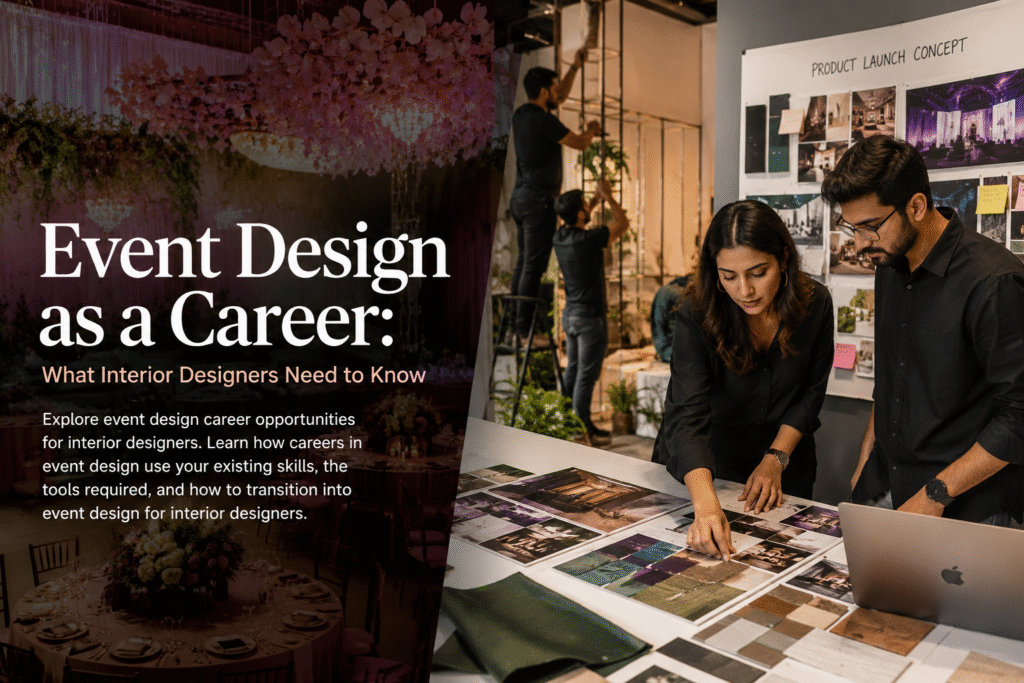
Explore event design career opportunities for interior designers. Learn how careers in event design use your existing skills, the tools required, and how to transition into event design for interior designers.
Picture this: a 500-person wedding reception transformed into an immersive garden suspended indoors, with custom floral installations, curated lighting that shifts across the evening, and every table, pathway, and lounge arranged to guide the guest experience with invisible precision. Or a global tech brand’s product launch where an empty warehouse becomes a cinematic world built entirely to reflect the brand’s identity, designed to generate social media moments and press coverage in equal measure.
Behind both of these experiences is not just a planner with a checklist. There is a designer, someone trained to think in three dimensions, to understand how space shapes human feeling and behavior, and to translate a brief into a visual world that communicates something specific and powerful. That designer is, increasingly, someone with a background in interior design.
Event design as a career is one of the most dynamic, fast-growing, and creatively demanding paths that interior designers can pursue. And unlike many career transitions, this one does not require starting over. The spatial thinking, material knowledge, client management experience, and visual storytelling skills that interior design education develops are the exact capabilities that professional event design demands. What changes is the context, the timeline, and the scale of creative ambition required.
India’s events industry was valued at over Rs. 10,000 crore in 2024 and is growing at a CAGR of 15 to 20% annually, driven by the booming wedding market, the expansion of corporate event culture, and the rise of experiential marketing as a primary brand strategy. For interior designers looking for a career in event design, the timing has never been more favorable.
What Is Event Design?
Event design is the practice of creating the visual, spatial, and experiential environment for an event, whether that is a wedding, a corporate conference, a product launch, a music festival, an exhibition, or a cultural gathering. It encompasses every element that shapes how guests perceive, move through, and feel within a space: the layout and flow of the venue, the lighting design, the installation of decor and furniture, the styling of table settings and stage areas, the choice of materials and color palette, and the overall sensory atmosphere created by the combination of all these elements.
Event design as a career is fundamentally about creating a complete sensory experience within a defined time and budget, with the additional challenge that the design exists only temporarily before being dismantled and reset for the next event. This ephemeral quality makes event design both uniquely creative and uniquely demanding: every project starts from a blank canvas, and every execution happens under real-time pressure.
Event Design vs Event Planning
One of the most important clarifications in understanding event design as a career is the distinction between event design and event planning. These are related but distinct disciplines that are too often conflated, both by clients and by professionals entering the field.
Event planning is the logistical management of an event: booking vendors, managing timelines, coordinating catering, handling guest registration, managing budgets and contracts, and ensuring that everything that needs to happen on the day of the event happens correctly and on time. Event planners are project managers who specialize in the operational complexity of gatherings.
Event design, by contrast, is the creative and spatial discipline that determines what the event looks, feels, and communicates. An event designer develops the creative concept for the event environment, specifies the visual and spatial elements that will bring that concept to life, directs the production and installation of all decor and structural elements, and oversees the overall aesthetic coherence of the finished environment. In large productions, event planners and event designers work in close collaboration. In smaller productions, the same professional often handles both disciplines. For interior designers entering careers in event design, it is the creative and spatial dimension that their training equips them for most directly.
Role of an Event Designer
The role of an event designer within any event design career encompasses several interrelated responsibilities that span the full lifecycle of a project. It begins with a detailed brief from the client, which the event designer must translate into a creative concept that reflects the client’s vision, brand identity, or occasion narrative while being practically executable within the available budget, venue, and timeline.
From the concept, the event designer produces detailed mood boards, spatial layouts, lighting plans, and material and decor specifications. These are presented to the client for review and approval before production begins. During the production phase, the designer works with a network of vendors including floral designers, furniture hire companies, lighting technicians, set builders, textile suppliers, and audio-visual teams to source and execute every element of the design. On the day of the event, the designer oversees installation, resolves any on-site challenges, and ensures that the finished environment matches the approved concept in every detail.
The breadth of this role makes event design as a career one of the most multi-dimensional applications of spatial and visual design skills, and one of the most demanding in terms of the speed and adaptability required. For designers who want to build or strengthen the spatial design foundation that supports this transition, the interior design programs at NIFD and the 3-year interior design course are structured to develop precisely these capabilities, from spatial planning and lighting design to client presentation and visual storytelling.
Why Interior Designers Fit Well in Event Design
Interior designers are among the best-prepared professionals for careers in event design precisely because their training develops the foundational capabilities that event design requires most. The transition from interior design to event design is not a departure from the discipline. It is an extension of it into a more dynamic and temporally compressed context.
Spatial Planning and Layout Skills
Spatial planning is the core technical skill of interior design and it is equally central to event design as a career. An event designer must understand how people move through a space, how different zones within a venue serve different functions, how the relationship between scale, proportion, and furniture placement affects the feel of an environment, and how a layout can guide or obstruct the guest experience.
Interior designers bring a formal training in these spatial principles that most event professionals develop only through years of on-the-job experience. The ability to read and produce scaled floor plans, to understand how sight lines and traffic flow interact, and to optimize a venue layout for both aesthetic and functional goals is a direct application of interior design spatial planning skills to event design for interior designers making the transition.
Styling, Lighting, and Visual Aesthetics
Visual aesthetics is the language of both interior design and event design. Interior designers trained in color theory, material selection, lighting design, and the visual principles of balance, contrast, rhythm, and emphasis are immediately equipped to apply these skills to the creation of event environments.
Lighting design is particularly valuable in careers in event design because lighting is one of the most powerful tools available to an event designer and one of the least systematically understood by planners and decorators without a design background. Understanding how light temperature affects the perceived color of fabrics and florals, how directional light creates architectural drama, and how layered lighting can transform a venue from a functional space into an immersive environment gives interior designers a significant creative and professional advantage in event design as a career.
Client and Concept Presentation Skills
Interior designers are trained to present spatial concepts to clients through mood boards, rendered visuals, material samples, and detailed drawings, and to guide clients through a design development process that moves from initial concept to final approval. These presentation and client management skills are directly transferable to event design for interior designers in professional practice.
In careers in event design, the ability to present a creative concept compellingly and persuasively, to manage client expectations across the development process, and to incorporate client feedback without losing the integrity of the design concept is as critical to professional success as the quality of the design work itself. Interior designers who have developed these skills through residential and commercial projects bring a level of professional polish to event design client relationships that is often a significant differentiator in winning and retaining high-value commissions.
Popular Career Paths in Event Design
Event design as a career encompasses a wide spectrum of project types and professional contexts. Understanding the major career paths within careers in event design helps interior designers identify where their existing skills and aesthetic sensibilities are most naturally aligned.
Wedding and Luxury Events
Wedding and luxury event design is the most visible and perhaps the most creatively rich segment of event design as a career in India. The Indian wedding industry is among the largest in the world, with an estimated annual value of over Rs. 4.25 lakh crore, and the design investment within premium and destination weddings has grown substantially as couples and families seek bespoke, highly personalized event environments that reflect their cultural heritage, aesthetic preferences, and personal narratives.
For interior designers transitioning to event design for interior designers through the wedding market, the parallel is direct: working with clients on a significant personal project that requires deep listening, strong concept development, and meticulous execution. Wedding designers in the premium segment work with budgets that allow for genuine creative ambition, custom fabrication, immersive installations, and the kind of total spatial transformation that interior designers most enjoy. Top wedding event designers in India earn Rs. 10 to Rs. 30 LPA and above, depending on the scale of their practice and the tier of client they serve.
Corporate and Brand Events
Corporate and brand event design is the most commercially structured segment within careers in event design, and it is one of the fastest-growing as brands increasingly recognize the value of physical events as a primary brand communication channel. Product launches, annual conferences, dealer meets, award ceremonies, brand experiences, and pop-up retail activations are all categories of corporate event design that require the spatial intelligence and visual brand sensitivity that interior designers bring.
Corporate event design as a career differs from wedding and luxury events in several important ways. The client is an organization rather than an individual or family, which means the design brief is driven by brand guidelines, communication objectives, and measurement criteria rather than personal aesthetic preferences. Projects are often larger in scale and more structurally complex, involving stage design, AV integration, and branded environments that must photograph and film well for media use. The timeline is typically more compressed, with less room for iterative development, making rapid visualization and decisive decision-making important professional skills.
Salaries in corporate event design are among the highest within careers in event design, with experienced designers at established event production companies earning Rs. 8 to Rs. 15 LPA and above. Freelance corporate event designers with strong brand client relationships can earn considerably more per project.
Exhibition and Experiential Design
Exhibition and experiential design is the most conceptually ambitious segment of event design as a career, sitting at the intersection of spatial design, brand communication, and immersive storytelling. Exhibition designers create environments for trade shows, product exhibitions, museum installations, cultural festivals, and brand experience zones that translate a brand’s or institution’s identity into a physical spatial narrative.
This is the segment of careers in event design that most directly rewards an interior designer’s ability to think conceptually about how space can communicate meaning, create emotional impact, and guide a visitor’s journey through a series of curated experiences. The best experiential design work combines architectural thinking with theatrical sensibility and brand intelligence, making it one of the most sophisticated applications of spatial design skills available to interior designers exploring event design for interior designers as a career direction.
Essential Skills for Event Designers
While interior designers bring significant foundational skills to event design as a career, the field also requires some capabilities that are specific to the event context and must be actively developed.
Creative Styling and Storytelling
Storytelling is the conceptual engine of all great event design. Every successful event environment communicates a narrative, whether it is the love story of a couple expressed through the visual language of their wedding design, the innovation positioning of a technology brand expressed through a product launch environment, or the cultural heritage of an institution expressed through an exhibition installation. Interior designers who develop the ability to build and articulate a coherent creative narrative, and to make every design decision in service of that narrative, bring a depth of conceptual intelligence to careers in event design that elevates their work beyond decoration into genuine spatial storytelling.
Vendor and Budget Coordination
Vendor coordination is one of the most practically critical skills in event design as a career, and it is one area where interior designers may need to build new expertise when transitioning to event work. Event design projects involve managing a complex network of specialist vendors including floral designers, furniture hire companies, textile and draping suppliers, lighting technicians, set builders, and audio-visual teams, often simultaneously across a compressed production timeline.
Building strong relationships with reliable vendors and understanding the realistic capabilities, lead times, and costs of each specialist is knowledge that develops through experience. Interior designers entering event design for interior designers should actively invest in building their vendor network from the earliest stages of their event career, attending trade exhibitions, visiting supplier showrooms, and collaborating on smaller projects to understand the production ecosystem that large-scale event design depends upon.
Time Management and Adaptability
The defining operational challenge of event design as a career is that everything must be ready by a fixed, immovable deadline: the event itself. This is qualitatively different from the project timelines of interior design, where, while deadlines exist, there is usually more room for iteration and adjustment. On an event installation day, the venue must be complete, the lighting must work, every prop must be in place, and every detail must be correct before the first guests arrive, regardless of what has gone wrong during setup.
The adaptability required to resolve unexpected problems quickly, calmly, and creatively, whether a key vendor has delivered the wrong items, a piece of structural decor has been damaged in transit, or the venue layout needs to change at the last minute, is one of the most important professional qualities for careers in event design. Interior designers who thrive under pressure and enjoy the dynamic unpredictability of on-site work tend to find the event context genuinely energizing.
Tools Used in Event Design
The tools used in event design as a career overlap significantly with the software and visualization methods that interior designers already use, making the technical transition into event design for interior designers relatively smooth.
AutoCAD and SketchUp
AutoCAD remains the industry standard for producing precise spatial layouts and floor plans in careers in event design, just as it is in interior design practice. Event designers use AutoCAD to produce scaled venue layouts showing furniture placement, traffic flow, stage positions, and decor zones. These technical drawings are shared with venue managers, production teams, and clients as the working document from which all physical installation is coordinated.
SketchUp is widely used in event design as a career for rapid three-dimensional concept modeling. Its relative ease of use compared to more complex modeling software makes it ideal for quickly visualizing a proposed event environment and communicating spatial concepts to clients without the time investment of highly detailed 3D production. Interior designers who are already proficient in SketchUp can apply these skills directly to event concept visualization.
Mood Boards and 3D Visuals
Mood boards are the primary creative communication tool in event design for interior designers and in event design practice generally. A well-constructed mood board communicates the aesthetic direction, color palette, material language, and atmospheric intent of a proposed event design in a format that clients can respond to emotionally before any commitment to production is made.
Three-dimensional visual renders, whether produced through SketchUp, Lumion, or dedicated event visualization software, are increasingly expected in high-value event design presentations as clients want to see as realistic a preview of the finished environment as possible before approving significant production investment. Interior designers proficient in visualization software bring a distinct advantage to careers in event design in this regard, as the ability to produce high-quality rendered previews of event environments is a service that many event decorators without a design background cannot offer.
Challenges in Event Design Careers
Event design as a career is genuinely rewarding, but it is also one of the more demanding professional paths that interior designers can pursue, and understanding its challenges honestly is important for those considering the transition.
The physical and logistical intensity of careers in event design is significant. Event design projects involve long installation days that often extend through the night before an event, heavy lifting and physical on-site work, and the management of large teams of installation crews across complex, multi-zone venue environments. The hours during event season are demanding, and the creative burnout associated with consistently delivering high-pressure, high-stakes projects requires active management.
Income seasonality is another practical challenge of event design as a career. The event industry in India is concentrated around wedding seasons (October to February and May to June) and the corporate event calendar (which peaks around product launches and year-end). Designers must plan their finances to accommodate lower-activity periods while sustaining the vendor relationships and marketing investment needed to attract the next season’s commissions.
The competitive intensity of the Indian premium event design market means that reputation and portfolio quality are the primary competitive differentiators in careers in event design. In a market where word-of-mouth and social media visibility drive the majority of high-value commissions, building and maintaining a visible and distinctive professional identity requires sustained investment in photography, digital content, and networking.
How to Start a Career in Event Design
For interior designers who want to pursue event design as a career, the transition is most effectively made through a deliberate, phased approach that builds relevant experience and portfolio content alongside the foundational training they already have.
Internships and Freelance Projects
The most direct path into careers in event design for interior designers is through hands-on experience with established event design studios or luxury event production companies. Approaching event companies for internship, assistant, or junior design roles allows you to learn the vendor ecosystem, the production workflow, and the on-site management dynamics of event design in a structured context before taking on independent projects.
For those already working as interior designers who want to add event design for interior designers to their practice, volunteering to design smaller events, collaborating on friends’ or family members’ weddings, or offering event styling services at reduced rates in exchange for portfolio photography are all effective ways to build the specific experience and visual documentation that event design as a career requires.
Building an Event-Focused Portfolio
An event-specific portfolio is essential for anyone pursuing careers in event design as a primary professional direction. Unlike an interior design portfolio, which documents permanent spaces through detailed drawings and photography, an event design portfolio centers on high-quality event photography that captures the finished environment in its most compelling light, alongside the concept development work that shows the designer’s creative process.
Professional event photography is a non-negotiable investment in event design as a career. The quality of your event photography determines how your work is perceived across every channel, from your personal website and social media presence to the print portfolio you bring to client meetings. Investing in a skilled event photographer for every significant project, even early in your career when budgets are tight, is one of the highest-return decisions you can make in building your event design practice.
Networking With Vendors and Brands
The event design industry runs on relationships. The vendors, photographers, caterers, venue managers, and brand event managers who become your professional network are both a source of referrals and a critical operational resource for delivering the projects you win. Careers in event design for interior designers are built on the same relational foundation as interior design practice, but the specific community is different and must be deliberately cultivated.
Attending trade exhibitions like India International Jewellery Show, Acetech, and WeddingWire events, following and engaging with the leading event design professionals in your city on social media, and collaborating with photographers, florists, and stylists on styled shoots that generate portfolio content are all effective strategies for building the professional network that event design as a career requires.
For a global perspective on the evolving standards and creative directions in professional event design, visit BizBash, the world’s most trusted resource for event design professionals covering industry trends, case studies, and career guidance across corporate, experiential, and luxury event markets.
Frequently Asked Questions
Yes, and they are exceptionally well-positioned to do so. The spatial planning, lighting design, material knowledge, client management, and visual presentation skills developed in interior design training are directly applicable to event design as a career. The primary additional skills needed for event design for interior designers are vendor coordination, production management, and the specific visual documentation and networking practices of the event industry.
Event design as a career is an excellent option for designers who thrive in fast-paced, project-based environments and enjoy the creative intensity of building complete spatial experiences within compressed timelines. India's events industry is growing at 15 to 20% annually, generating strong and consistent demand for professionally trained event designers, particularly in the premium wedding, corporate, and experiential design segments.
The core skills for careers in event design are spatial planning and layout, creative concept development and storytelling, lighting and visual aesthetics, vendor and budget coordination, time management under pressure, and strong client communication and presentation abilities. Interior designers bring most of these skills as foundational competencies; vendor coordination and production management are the areas typically requiring the most focused development when transitioning to event design for interior designers.
Yes. AutoCAD is used for scaled venue layouts and technical planning documents, while SketchUp and similar tools are used for rapid three-dimensional concept visualization. Mood boards and photorealistic renders are standard presentation tools in event design as a career, and proficiency in these tools gives interior designers a significant professional advantage when entering careers in event design.
Yes, and freelancing is in fact the most common professional model in event design as a career, particularly at mid-career and senior levels. Many established event designers operate as independent practitioners or through small boutique studios, taking on individual commissions rather than working within larger event companies. Building the client base and vendor network required to sustain a successful freelance event design practice typically takes two to three years of studio experience and active professional networking.
Careers in event design span a wide range of industries. Wedding and luxury event companies, corporate event production agencies, experiential marketing and brand activation firms, hospitality groups managing conference and banqueting facilities, exhibition design companies, film and television production studios, and cultural institutions managing exhibitions and public events all hire professional event designers. Designers with a strong portfolio and versatile event design skillset are well-positioned to work across multiple industries simultaneously.
For a comprehensive global perspective on interior design industry trends, career development, and the evolving standards of professional practice, visit Dezeen’s Interior Design Career Guide, one of the most trusted international platforms for design professionals worldwide.
Ready to build the foundation for a successful interior design career path? Explore NIFD’s interior design programs and discover the 3-year interior design degree course that gives you the technical skills, portfolio depth, and industry connections to launch your career with confidence.