Most students who choose to study fashion design have a picture in mind of what the job looks like: sketching original creations, selecting fabrics, watching garments come to life on a runway. That picture is not wrong, but it is incomplete. What a fashion designer actually does inside a professional fashion house is shaped as much by collaboration, deadlines, revision cycles, and production coordination as it is by creative ideation. The gap between expectation and reality is wide enough that students who arrive at their first professional role unprepared for it often find the transition harder than it needs to be.
This guide takes a direct look at fashion designer job responsibilities inside a fashion house, covering how design teams are structured, what a working day actually involves, how a collection moves from first idea to finished garment, and what skills and habits employers genuinely value at every career stage. For a broader view of where these roles fit in the wider career landscape, the career options after fashion designing course guide is the most comprehensive starting point. And for students preparing to enter the market as new graduates, the fashion designer jobs for freshers guide covers specifically how to position yourself for entry-level roles.
How Does a Fashion House Work? Understanding the Design Team
A fashion house is not a single creative mind producing work in isolation. It is a structured organisation where multiple specialisations work together to bring collections from concept to consumer, and understanding that structure is essential context for anyone wanting to work inside one.
The creative director or head designer sits at the top of the design hierarchy and is responsible for the overall creative vision of the brand. They determine the aesthetic direction of each season, sign off on major design decisions, and represent the brand’s identity to the press, buyers, and retail partners. In larger houses, the creative director may not be directly involved in the day-to-day design process, working instead through senior designers who translate the broader vision into specific collection pieces.
Senior and junior fashion designers occupy the core of most design teams. Senior designers take responsibility for specific product categories or design directions within a collection, often mentoring junior colleagues and presenting work in internal review meetings. Junior fashion designers support the design process with research, illustration, design development, and coordination tasks while developing their skills and professional judgment under supervision. Textile and print designers focus specifically on the surface of garments: developing prints, embroidery, embellishment, and fabric manipulations that give a collection its distinctive material character. These roles may sit within the core design team or as a separate specialisation depending on the size and structure of the house.
Pattern makers and garment technicians are the technical bridge between a design sketch and a physical garment. They interpret design drawings into accurate patterns, manage toile development, and work directly with sampling teams to ensure garments are constructed correctly. Sampling and production teams handle the physical construction of prototype garments and, once designs are approved, coordinate the manufacturing process that brings a collection to scale. Understanding how all of these functions connect is part of what fashion designers do even at the junior level, because effective collaboration with each team is what moves a design from idea to reality.
What Are the Main Responsibilities of a Fashion Designer in a Fashion House?
The fashion designer job responsibilities inside a fashion house cover a broader range of activities than most students initially anticipate, spanning creative, technical, and coordination functions throughout the design and production cycle.
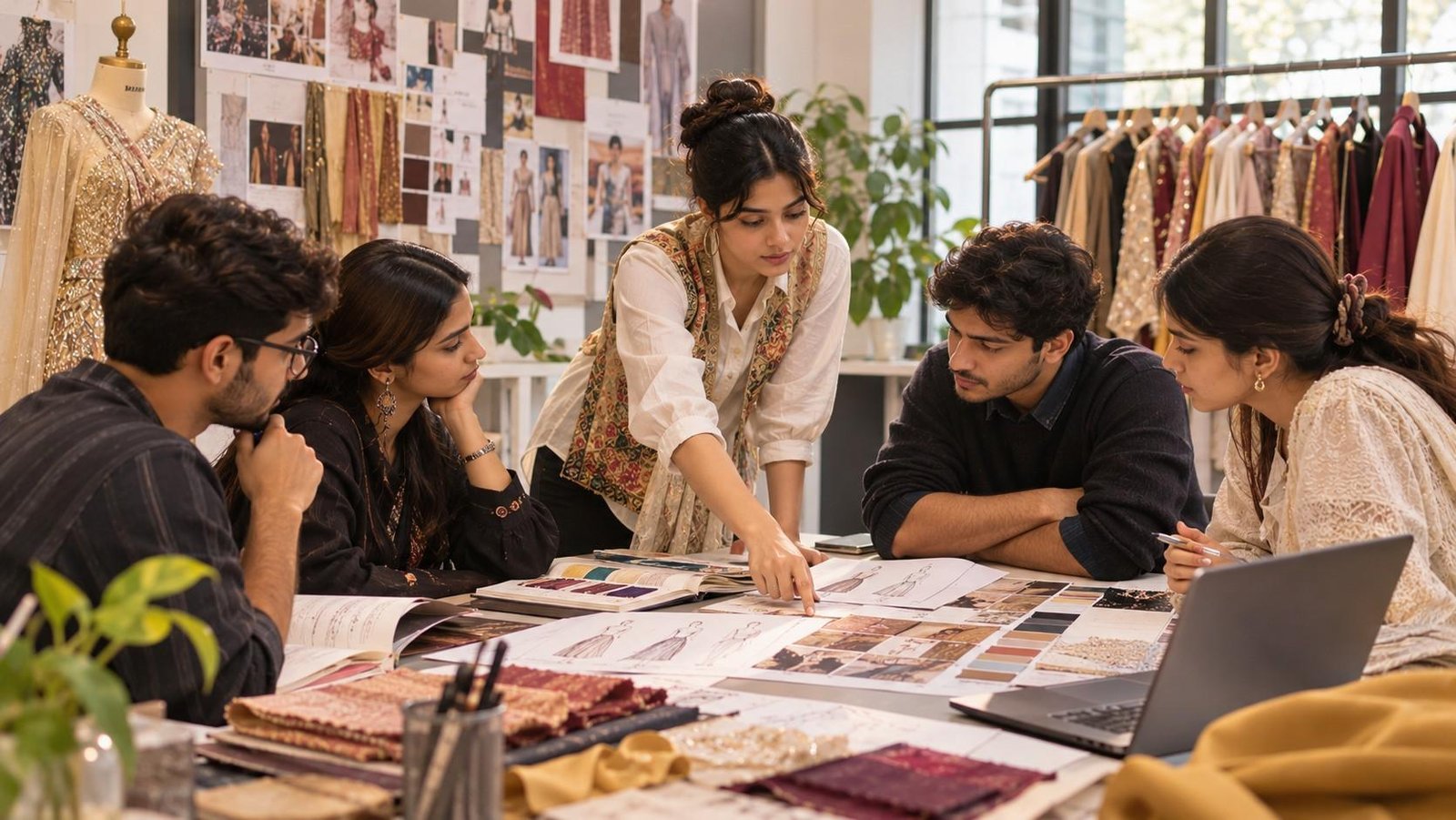
Researching fashion trends and consumer preferences is the foundation of every collection. Fashion designers study colour and trend forecasting reports, analyse competitor ranges, monitor street style and cultural movements, and assess what the brand’s target consumer is currently buying and responding to. This research is not passive background reading; it directly shapes which design directions are developed and which are discarded. Developing collection concepts and mood boards translates that research into a creative direction. Designers assemble visual reference boards that communicate the season’s colour palette, silhouette direction, texture and material story, and overall aesthetic tone. These boards are presented to creative directors and senior teams for approval before design development begins, and they serve as a navigational reference throughout the design process.
Creating fashion illustrations and technical sketches is where the concept becomes specific. Fashion illustrations communicate the look and mood of a design; technical sketches, also called technical flats, communicate exactly how the garment is constructed, including seam placement, pocket positions, closure types, and construction details. Both are part of a fashion designer’s core output, and the balance between them shifts depending on the stage of development. Selecting fabrics, colours, and materials is an active, judgement-intensive task rather than a simple aesthetic preference. Fashion designers work with fabric suppliers and textile agents to source materials that serve the design intent, meet cost requirements, and are available in the quantities and lead times the production schedule demands. Coordinating with pattern makers and sampling teams is a constant throughout the development process. Designers communicate design intent to technical teams through sketches, specification sheets, and direct conversation, then review the resulting toiles and samples to assess whether the garment matches the design and brief.
Reviewing garment samples and suggesting improvements is one of the most practically important and frequently underestimated fashion designer responsibilities. A sample rarely comes back exactly right the first time. Designers assess fit, construction, proportion, and finish against the design specification and provide precise, actionable feedback that allows the technical team to correct the garment accurately. Working with production teams to finalise collections brings the design process to its conclusion. Once samples are approved, designers work with production coordinators to ensure specifications are communicated accurately to manufacturers and that any last-minute adjustments are documented and applied. The fashion design internship guide describes how students begin engaging with these responsibilities during internship placements, which is often where the full scope of the role becomes clear for the first time.
What Does a Fashion Designer’s Typical Working Day Look Like?
A typical working day for a fashion designer in a fashion house does not follow a fixed script, but it has a consistent rhythm shaped by where the team is in its design and production calendar. The balance of activities shifts significantly depending on whether the team is in research and concept phase, active design development, sampling, or approaching a collection deadline.
Reviewing design briefs and collection requirements typically occupies the beginning of the day, particularly in the earlier stages of a design cycle. This means checking the season’s creative direction documents, reviewing outstanding design tasks, and understanding what needs to be resolved before the next internal review meeting. Attending design and development meetings is a regular feature of professional life in a fashion house. These meetings may involve presenting new design directions for feedback, reviewing sample outcomes with technical teams, checking in with sourcing on fabric availability, or aligning with merchandising on range planning. Communication across functions is constant, and the ability to present and discuss work clearly is a professional skill that matters as much as the design ability itself.
Working on sketches and design revisions is the core creative activity of the design phase, often happening in intensive bursts between meetings and coordination tasks rather than in long uninterrupted blocks. Reviewing fabric samples and garment prototypes involves assessing physical materials against design requirements, noting where samples meet the spec and where corrections are needed, and communicating feedback to the relevant teams. Coordinating with different departments, including sampling, buying, production, and sometimes marketing, is a consistent part of what fashion designers do even at the junior level. The ability to work across functions professionally and communicate precisely is as valued by employers as technical design skill. The top skills needed to become a fashion designer guide gives a complete breakdown of the capabilities that professional employers evaluate at every stage.
How Does a Fashion Collection Move From Concept to Final Product?
Understanding the full journey of a fashion collection from initial inspiration to finished garment is one of the most practically useful things a student can learn before entering the industry. It is the framework within which fashion designer job responsibilities are organised, and it explains why the work happens in the sequence that it does.
Research and inspiration is the starting point for every collection. Designers gather visual and contextual material from multiple sources: trend forecasting services, historical archives, travel, art, film, street culture, and direct observation of consumer behaviour. This research is filtered through the brand’s creative identity to identify the directions that are relevant and commercially appropriate for the season. Concept and collection planning takes that research and shapes it into a coherent creative direction. The team agrees on the season’s colour story, the key silhouettes, the material direction, and the number of pieces in each product category. These decisions are documented in a collection plan that guides all the design work that follows.
Sketching and design development is where individual garments are conceived, drawn, and developed across multiple rounds of review. Designers produce initial concept sketches, present them for feedback, refine the best directions into detailed design illustrations, and produce the technical flats from which pattern makers work. This phase involves significant revision work, and the ability to respond to feedback constructively and quickly is a defining professional skill. Fabric selection and sampling run in parallel with design development. Designers work with fabric suppliers to identify and confirm the materials for the collection, while pattern makers and sample machinists begin constructing the first prototype garments from approved designs.
Fittings and design modifications are where the garment is assessed on a live body for the first time. This is often the stage where the difference between a design that works on paper and one that works as a wearable garment becomes apparent. Fit issues, proportion adjustments, and construction modifications are identified and fed back into the development process. Production and final presentation mark the end of the development journey. Approved designs are handed over to production with full technical specifications, and the final collection is prepared for its presentation to buyers, press, or retail partners. The what do you actually make during a fashion design course guide explains how student project work mirrors this professional process, and why understanding it before graduation is a genuine advantage.
What Skills Do Fashion Houses Expect From Fashion Designers?
Fashion designer job responsibilities are underpinned by a specific set of skills, and fashion houses expect incoming designers to have developed the foundational versions of most of them before they begin their first professional role.
Creativity and visualisation is the starting point, but it is worth being specific about what professional creativity looks like in a fashion house. It is not simply having original ideas; it is the ability to generate ideas within a defined creative brief, to filter those ideas against commercial and production constraints, and to develop the strongest directions through multiple rounds of revision into resolved, producible garments. Fashion illustration and technical drawing are distinct skills that both matter. Fashion illustration communicates mood, proportion, and aesthetic intent; technical drawing communicates construction detail, measurement, and specification. Senior designers may sketch quickly and trust junior colleagues to develop full technical documentation, but most professional roles require competence in both.
Textile and fabric knowledge distinguishes designers who can make informed material decisions from those who can only describe what they want in general terms. Understanding how different fabric types behave, drape, construct, and wash; how to read a fabric specification sheet; and how to communicate material requirements precisely to suppliers is knowledge built through hands-on practice over time. Pattern making and garment construction awareness does not require every fashion designer to be a skilled pattern maker, but it does require an understanding of how patterns translate design intent into cut fabric, how construction choices affect the finished garment, and how to communicate clearly with technical specialists.
Digital design and communication skills include proficiency in Adobe Illustrator for technical flat drawing, Photoshop for design presentation, and increasingly tools such as CLO3D for three-dimensional garment visualisation. The software skills interior design students should develop before graduation guide is a useful adjacent reference, as the software skill-building principles it covers apply equally in fashion. Teamwork and deadline management are professional competencies that sit alongside but are entirely distinct from creative ability. Fashion houses operate on seasonal calendars with fixed deadlines, and the ability to manage your own workload, communicate proactively about progress, and work constructively with colleagues across different functions is what makes creative talent professionally functional.
How Do Fashion Designer Responsibilities Change With Experience?
Fashion designer job responsibilities are not fixed; they evolve substantially as a designer progresses through the career hierarchy, and understanding that progression helps students set realistic expectations for their early professional years.
A fashion design intern works in a support capacity, assisting with research, mood board preparation, fabric organisation, technical drawing, and sample room coordination. The work is real and directly connected to live collection development, but it happens under close supervision and within a tightly defined scope. This is where many students first encounter the full breadth of what fashion designers do in a professional environment. A junior fashion designer takes on more independent design tasks while still working within defined boundaries. They develop designs for specific product categories or collection segments under the direction of a senior designer, contribute to design presentations, and are expected to manage their own workload within the team’s calendar. Building technical accuracy and speed during this stage is what most effectively positions a junior designer for progression.
A mid-level fashion designer takes ownership of a specific category or design direction within a collection, presenting work directly to the creative director, mentoring junior colleagues, and managing design development from concept through to sampling independently. Senior fashion designers shape the creative direction of a category or brand segment, manage broader team relationships, and contribute to strategic decisions about the collection’s commercial and aesthetic positioning. The design manager or creative director role moves beyond direct design production into the leadership of the design function, managing people, creative strategy, and in many cases external relationships with buyers, press, and retail partners. The how to advance from junior to senior interior designer guide describes a career progression framework that maps closely to the equivalent trajectory in fashion design.
How Can Students Prepare for Working in a Fashion House?
The most effective preparation for a professional role in a fashion house is a combination of technical skill development, practical project experience, and direct exposure to real industry environments, all built consistently throughout a fashion design programme rather than concentrated in its final months.
Building a portfolio through practical projects is the most tangible preparation students can do. Every student project should be documented thoroughly, from research and mood board through to technical drawings and final garment, and the portfolio should be curated to show both creative thinking and technical capability. Employers reviewing applicants for fashion designer roles look for portfolios that demonstrate a coherent design process, not just polished final images. The what do you actually make during a fashion design course guide explains how to approach student projects as professional portfolio material from the outset.
Understanding garment development processes means engaging seriously with the technical subjects in a fashion design programme, particularly pattern making, garment construction, and textile science. Students who graduate with a working understanding of how garments are physically made are significantly more useful to design teams from day one than those who have focused exclusively on the creative aspects. Developing technical and creative skills in parallel, rather than treating one as more important than the other, reflects how professional fashion designers actually work. Gaining internship and industry exposure is the single most effective way to close the gap between academic training and professional readiness. An internship places a student inside a real design process, with real deadlines, real feedback, and real colleagues, in ways that no classroom exercise can replicate. The fashion design internship guide is worth reading before applying for any placement.
Learning to work with feedback and design deadlines is a professional discipline that students can begin developing during their studies. Treating tutor critique as a professional feedback session, working to assignment deadlines with the same seriousness as a commercial calendar, and practising the communication skills needed to present and discuss work in a group setting all translate directly into professional capability. The fashion design student checklist before graduation guide provides a full audit of everything students should have in place before they enter the job market.
How INIFD Helps Students Build a Foundation for Fashion Industry Careers
INIFD’s fashion design programmes are structured to develop the range of technical, creative, and professional skills that fashion houses consistently expect from candidates, whether they are applying for internships, junior design roles, or design assistant positions at any market level.
The curriculum builds practical skills progressively from the foundational level, with garment construction, pattern awareness, textile science, fashion illustration, and digital design tools integrated across semesters rather than treated as isolated subjects. Students work on a consistent body of project work throughout the programme, which becomes the portfolio they take into the job market. This portfolio development is treated as an ongoing professional activity from the first year of study, not a final-semester exercise. Industry-oriented skill development is embedded in the programme through exposure to live project briefs, guest professional sessions, and fashion show participation that places student work in a professional context before graduation. INIFD’s industry connections and placement support give students access to internship opportunities with real fashion brands and design studios, providing direct exposure to fashion designer job responsibilities in a working environment. Graduates enter the market with both the evidence of their skills and the professional context to present them effectively. The what employers actually look for in fashion design graduates guide clarifies exactly what hiring teams evaluate and how INIFD’s programme is designed to develop those specific capabilities.
Conclusion: Turning Fashion Design Education Into Industry Skills
What a fashion designer actually does in a fashion house is not a mystery, but it does require honest engagement with the full scope of the role before you arrive at your first professional position. The creative work, the technical coordination, the revision cycles, and the cross-functional collaboration are all part of the same professional practice, and each of them is learnable through the right combination of academic training and direct industry exposure.
Students who approach their fashion design education with clarity about what professional fashion designer job responsibilities actually involve are better placed to build the skills that matter, assemble the portfolio evidence that employers evaluate, and perform confidently in their first professional role. The foundation is built during the course. The fashion designer vs fashion merchandiser guide is worth reading alongside this one if you are still weighing your career direction, and the how to compare fashion institutes on 8 key factors guide provides a structured framework for evaluating where to build that foundation.
Frequently Asked Questions
No. In most fashion houses, collection development is a team effort. Senior designers and creative directors set the direction; fashion designers at different levels develop specific pieces or categories, with technical specialists handling pattern making and garment construction. Individual design ownership depends on the size of the team and the stage of career.
This varies considerably by the size of the fashion house and the scope of the collection. A junior fashion designer might be responsible for a small group of pieces within a wider collection; a senior designer might oversee a full category of thirty to fifty garments across colourways and fabrications.
The balance shifts across the design calendar. During concept and development phases, sketching and design work predominate. During sampling and pre-production, coordination with pattern makers, sample teams, and production becomes the primary activity. Neither is less important than the other.
A fashion designer develops and executes specific garments and design directions within a collection. A creative director sets the overall aesthetic vision of the brand, manages the design team, and is responsible for how the brand is perceived across all touchpoints. Creative direction is typically reached after significant design experience rather than as an entry point.
Not at the level of a specialist pattern maker, but they need a working understanding of how patterns work, how construction choices affect the finished garment, and how to communicate precisely with technical teams. Designers who lack this understanding frequently find their intentions are lost in translation between sketch and sample.
Entry-level roles and internships at luxury houses are competitive but accessible to graduates with a strong portfolio, relevant technical skills, and genuine knowledge of the brand's aesthetic. Most freshers begin in assistant or intern roles, building industry experience before moving into junior designer positions.
Junior fashion designers typically work most closely with the design team, pattern making team, and sampling team on a daily basis. They also interact regularly with the fabric sourcing team and, depending on the organisation, with merchandising and production.
Yes, particularly at mid-level and senior stages of a career. Merchandising teams provide commercial intelligence that shapes which designs are developed and in what quantities. Marketing teams use design output for campaign and content production. Understanding how design decisions affect commercial outcomes is part of fashion designer job responsibilities as a career develops.
Adobe Illustrator is the near-universal standard for technical flat drawing. Adobe Photoshop is widely used for presentation work and print design. CLO3D and other three-dimensional garment visualisation tools are increasingly used in larger organisations. Proficiency in Illustrator specifically is a baseline expectation at most professional fashion employers.
Through internships, personal design projects, competition entries, and self-initiated briefs that demonstrate professional-level design thinking and technical capability. A well-documented portfolio of project work completed during a fashion design programme, combined with at least one internship in a professional environment, is the standard preparation for entry-level roles in fashion houses.