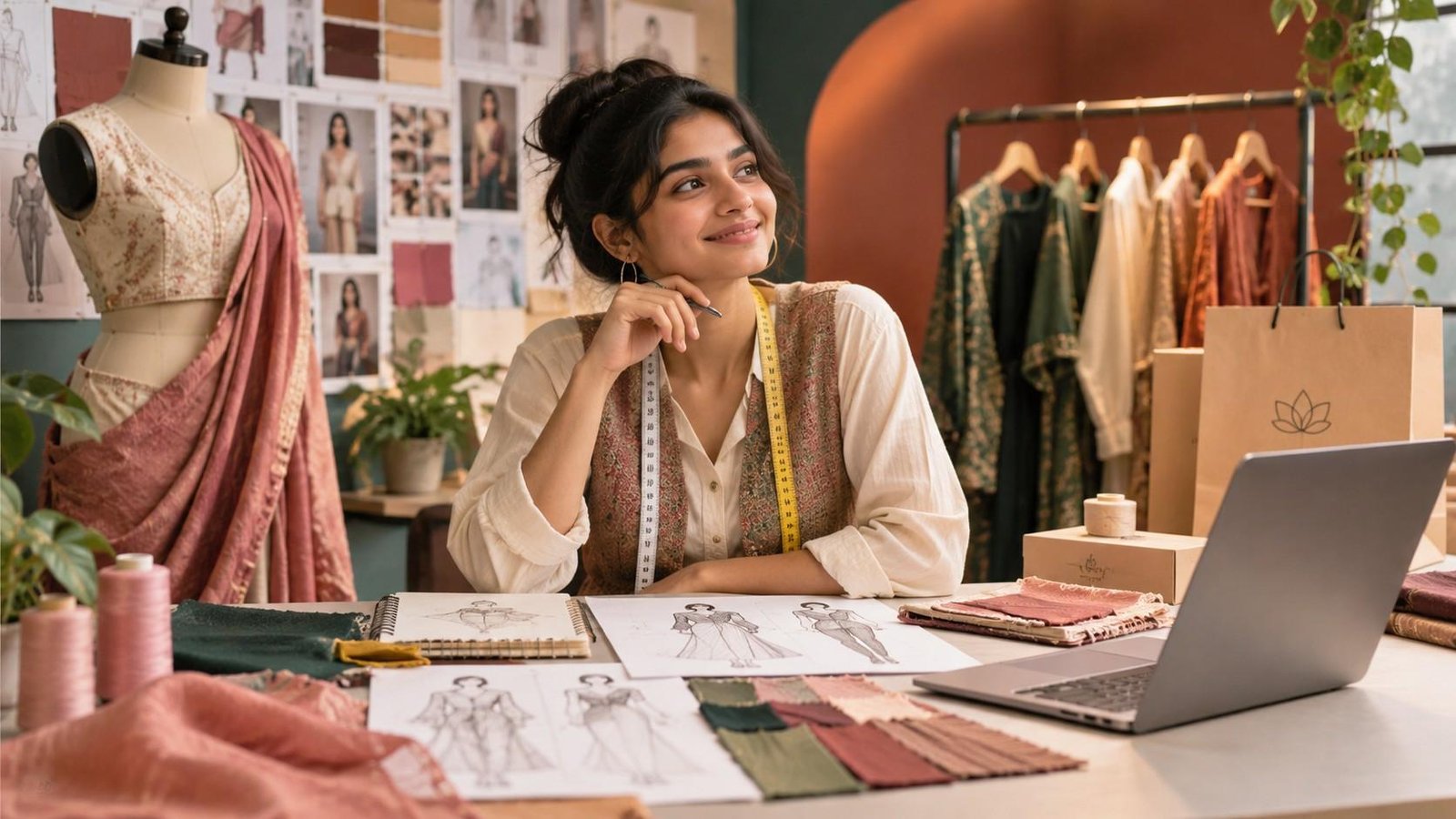
Fashion design education gives students the creative and technical foundation to bring clothing to life, but turning that foundation into a working business requires a different kind of preparation. How to start a clothing brand is a question many graduates ask within months of completing their studies, and the answer involves far more than designing appealing garments. It requires understanding a market, building a production process, managing costs, and finding the customers who will actually buy what you make.
The good news is that the skills developed through a fashion design programme, from garment construction and textile knowledge to trend research and collection development, are the right starting materials for building an independent label. The challenge is translating those creative skills into a commercially viable business without the common mistakes that cause most early-stage labels to stall before they find their audience. For students who are still weighing their career direction before making this commitment, the freelance fashion designer vs full-time job guide and the fashion designer vs fashion merchandiser guide are worth reading alongside this one.
Why Fashion Design Education Is the Right Starting Point for a Clothing Brand
Understanding how to start a fashion brand well begins with recognising what a fashion design education actually provides, beyond the visible creative output. Students who complete a structured fashion design programme develop something that is genuinely difficult to build any other way: a working understanding of how clothing is made.
Developing an understanding of fashion trends and consumer preferences is built into the research and design process from the first semester. Students learn to study the market, analyse what consumers are responding to, and identify where there are gaps between what is available and what a specific audience actually wants. This research habit, applied to your own brand’s target market, is the first real competitive advantage a trained designer has over someone who launches a label based on personal taste alone.
Building practical design skills before investing in a business means arriving at your first production run with the ability to communicate precisely with manufacturers, review samples with technical accuracy, and make informed decisions about fabric, construction, and fit. These capabilities reduce the most expensive errors in the early stages of running a label: garments that do not fit, samples that miss the design intent, and fabric choices that look wrong on a finished product. Why creative ability and business knowledge need to work together is perhaps the most important lesson a designer can carry into entrepreneurship. A label that produces beautiful clothing but cannot manage its costs, communicate its identity, or find its customers will not survive long enough to refine its product. The fashion design eligibility criteria guide gives useful context on the range of knowledge and skills a well-structured programme builds across its duration.
Step-by-Step Guide to Starting a Clothing Brand After Graduation
1. Decide What Kind of Clothing Brand You Want to Build
The first decision in starting a clothing brand is also the one that shapes every decision that follows: what kind of label are you building, for whom, and why? Women’s wear, men’s wear, children’s wear, and unisex clothing each have different production dynamics, different customer behaviour, and different competitive environments. Ethnic wear, streetwear, casualwear, occasionwear, and sustainable fashion each have their own market logic and customer expectations.
Identifying a specific customer group and their needs is more important than choosing a category. The most successful early-stage labels are not those that try to appeal to everyone in a broad category; they are the ones that understand a narrow, specific audience deeply enough to design and market directly to them. A label for young professional women in Tier 2 Indian cities who want office-appropriate ethnic fusion wear has a clearer product brief, a more identifiable customer, and a more focused marketing approach than “women’s ethnic wear.” The more precisely you can describe the person you are designing for before you produce a single garment, the more effective every subsequent decision becomes.
2. Research Your Market and Competitors
Market research for a clothing brand is not a one-time activity done before launch; it is an ongoing practice that informs every collection decision throughout the life of the label. Before your first collection, it means understanding customer preferences and purchasing behaviour: where your target customer currently shops, what price points they are comfortable with, what they are not finding in the market that they would buy if it existed.
Studying competing brands, pricing, and product ranges gives you a realistic picture of what already exists and helps you position your label clearly against it. The goal is not to copy what competitors are doing but to understand it well enough to identify where your label offers something genuinely different. Identifying gaps your clothing label could address is the commercial outcome of thorough market research. A gap might be a price point that is not served, a specific fabric or construction approach that no existing brand is using, an underserved customer segment, or a combination of aesthetic and function that existing options do not offer.
3. Develop Your Brand Identity
A clothing brand’s identity is not its logo; the logo is one expression of an identity that must exist first. Choosing a brand name and positioning starts with understanding what your label stands for: who it serves, what it values, and what makes it different from every other option the customer could choose. The name should be memorable, available to register, and consistent with the positioning you are building.
Defining the brand’s design language and aesthetic gives every collection its internal coherence. What silhouettes, proportions, fabrics, and details characterise your label’s clothes? What does a customer recognise as yours across different seasons and categories? Creating a logo, colour palette, and visual identity gives the brand a consistent visible presence across packaging, social media, swing tags, and every other customer touchpoint. Establishing what makes the label recognisable is the cumulative result of consistent creative and commercial decisions made over time, beginning with the very first collection.
4. Create Your First Clothing Collection
The most common mistake in a first collection is trying to show too much. Selecting a theme and developing a collection concept gives the range its creative and commercial coherence. A focused theme does not limit creativity; it provides the structure within which creative decisions become clear and efficient. Preparing mood boards, colour stories, and design sketches is the design development process applied to your own label rather than a client’s brief. The same rigour that makes a student project successful, thorough research, resolved concept, technically accurate drawings, applies directly here.
Choosing fabrics, trims, and suitable materials is where your textile knowledge from training pays its first commercial dividend. Understanding how fabric behaves, how it costs out at different quantities, and how to source it reliably is the difference between a collection that is achievable and one that exists only in your mood board. Developing samples and refining garment details requires patience and willingness to iterate. The first sample is almost never the final version, and treating each sample round as a learning opportunity rather than a failure produces a finished garment worth producing. Building a focused first collection rather than launching too many products keeps your costs manageable and your identity clear. Six to twelve pieces done exceptionally well is a stronger launch than thirty pieces done adequately.
5. Find Fabric Suppliers and Manufacturers
Exploring fabric markets, wholesalers, and textile suppliers is a process that takes time to do well, and the time spent building supplier relationships before your first production run pays significant dividends later. India’s major textile markets, from Surat for synthetics to Ludhiana for knitwear to Chandni Chowk for a wide range of wovens, are starting points, but finding reliable suppliers who will work consistently with a small emerging label requires direct conversations and sample testing.
Understanding minimum order quantities and production capacity is essential before you commit to any supplier or manufacturer. Many established suppliers have minimums that exceed what a new label can viably produce, and working with suppliers whose minimums align with your early volumes avoids overcommitting inventory before you know what will sell. Comparing sampling, stitching, and manufacturing options across multiple vendors before committing to any one is standard commercial practice. Checking quality, timelines, and consistency before placing larger orders means testing a manufacturer with a small batch before scaling up. A manufacturer who is excellent at sampling but inconsistent at production scale is a risk that becomes apparent only through direct experience with their work.
6. Calculate Your Costs and Set Product Prices
Pricing a clothing brand’s products is one of the areas where new designers make the most consequential and most avoidable errors. Fabric and material costs are the most visible component of cost but rarely the only significant one. Sampling and manufacturing expenses, particularly the cost of multiple sampling rounds before a garment is approved, add up quickly and are often underestimated by designers who have not managed a production budget before.
Packaging, shipping, and marketing costs are operational expenses that exist entirely outside the garment itself but are essential to getting the product to the customer. Pricing based on production costs, positioning, and target customers requires a clear understanding of all costs, a realistic assessment of what your target customer will pay, and a margin that allows the business to operate and invest. A price that the market will accept but that leaves no margin for error or reinvestment is not a sustainable price. Planning for returns, unsold inventory, and future expenses is the commercial discipline that separates labels that survive their first year from those that do not.
7. Complete the Business and Legal Setup
Choosing an appropriate business structure, whether a sole proprietorship, a partnership, or a private limited company, depends on your circumstances, your plans for the business, and the tax and liability implications of each option. Advice from a chartered accountant is worth securing before you formalise anything.
Understanding applicable registrations, tax, and compliance requirements in India includes GST registration once your turnover crosses the relevant threshold, any state-specific requirements for manufacturing or trading in clothing, and trademark registration if you want to protect your brand name. Protecting your brand identity where appropriate means registering your brand name and logo as trademarks before they become well-known enough to be worth copying. Maintaining clear records of business expenses and transactions from the first day of operation makes tax compliance straightforward and gives you an accurate picture of your actual costs and profitability.
8. Choose Where You Will Sell Your Clothing
Your own ecommerce website gives you complete control over how your brand is presented, your customer data, your margin, and your brand story. It requires investment in development, photography, and ongoing marketing to generate traffic, but it builds an asset that is entirely yours. Social media and direct-to-customer sales through Instagram, WhatsApp, and other platforms are where many Indian independent labels build their earliest customer base, because the cost of entry is low and the ability to present the brand visually is strong.
Online marketplaces such as Myntra, Nykaa Fashion, and Amazon Fashion offer access to large existing customer bases but typically require meeting category and quality standards and involve significant commission structures. Pop-ups, exhibitions, and retail partnerships generate direct customer interaction and brand awareness in ways that online channels cannot replicate, and they are particularly effective for labels whose product is best understood in person. Selecting channels based on your audience and budget is the practical outcome of understanding where your specific customer actually shops and what you can consistently invest in reaching them.
9. Market Your Clothing Brand and Find Your First Customers
Professional product photography and lookbooks are the foundation of everything else in your marketing. Clothing is a visual product, and the quality of how it is photographed directly determines how it is perceived. Investing in professional photography before launch, even if it means producing fewer garments in the first collection, is consistently worth it.
Social media content and behind-the-scenes storytelling builds the audience that converts into customers over time. Showing your design process, your fabric sourcing, your sampling rounds, and the people behind the label gives a clothing brand a human identity that generic product posts cannot create. Influencer collaborations and launch campaigns can accelerate early awareness when the right collaborators are chosen, meaning people whose audience genuinely matches your target customer. Customer feedback, reviews, and repeat-purchase strategies are where a launched clothing brand builds the evidence of its quality and the relationships that sustain it beyond the initial launch period.
How Much Does It Cost to Start a Clothing Brand in India?
The honest answer to how to start a fashion brand on a specific budget is that investment varies considerably depending on product category, collection size, and production model, and any figure presented as a fixed minimum is likely to be misleading.
A made-to-order model, where garments are produced only after a customer has paid, is the lowest-capital approach to launching because it eliminates the risk of unsold inventory. It requires longer lead times for customers and demands reliable, responsive manufacturing partners, but it allows a label to test demand before committing to bulk production. A small-batch inventory model, producing fifty to two hundred pieces per style before selling, requires a larger upfront investment but allows faster fulfilment and more consistent quality control. The key cost heads in either model are sampling, fabric, manufacturing, photography, packaging, and the initial marketing investment to generate awareness. Testing demand before scaling production, through pre-orders, made-to-order launches, or pop-up events, is the most financially sensible approach for most independent labels in their first season.
Common Mistakes to Avoid When Launching Your First Clothing Label
Launching without a clearly defined customer is the most foundational error a new clothing brand can make. Without a specific customer in mind, every design decision, pricing decision, and marketing decision lacks a clear reference point, and the result is a label that appeals to no one strongly enough to generate loyal repeat customers.
Ordering too much inventory too early is the most common financial error. The temptation to reduce per-unit costs through larger order quantities is understandable, but the working capital tied up in unsold inventory in the first season has ended more promising labels than it has helped. Underestimating production and marketing costs catches most first-time founders by surprise, because the visible cost of the garment is only one component of the total investment required to bring it to a paying customer. Ignoring garment quality and fit is a risk that fashion design training should guard against, but commercial pressure to reduce sampling rounds or accept a good-enough sample is a real dynamic in production. The standard your training has given you for what a well-made garment looks and feels like is exactly the standard to maintain.
Copying competitors instead of developing a distinct identity produces a label that is permanently positioned behind the brands it is imitating. Focusing only on social media without a sales strategy is a common pattern in independent labels: strong content, a growing audience, and no clear mechanism for converting that audience into revenue. Social media is a marketing channel, not a sales system, and both need to exist and work together.
How INIFD Can Help You Build the Foundation for Your Own Fashion Brand
INIFD’s fashion design programmes develop the specific creative, technical, and commercial knowledge that aspiring independent designers need before launching their own label. The curriculum builds practical design skills through project work that mirrors real production processes, from concept development and mood board creation through to fabric selection, garment construction, and collection presentation.
Students develop a working understanding of how garments are made, how textile choices affect design outcomes, and how to communicate design intent precisely to production teams, all of which are directly applicable to running a clothing brand independently. The programme’s industry exposure, including internship placements and live project opportunities, gives students direct experience of how professional fashion businesses operate before they attempt to build one of their own. Portfolio development throughout the programme means that by graduation, students have the body of creative work and the professional presentation skills to begin building a label identity from a position of genuine capability rather than untested aspiration. The habits of research, iteration, and commercial awareness that the programme develops are exactly what the transition from student to independent designer demands.
Conclusion: Turning Fashion Design Education Into a Fashion Business
Starting a clothing brand after studying fashion design is one of the most direct applications of everything a fashion education develops, and it is a path that rewards careful preparation at every stage. The creative foundation is necessary, but it is not sufficient. Market research, production planning, cost management, brand identity, and customer acquisition are the commercial competencies that determine whether a label survives and grows or stalls after its first collection.
The designers who build sustainable independent labels are those who approach the business side of how to start a fashion brand with the same rigour they bring to their creative work, who test their assumptions before committing significant capital, and who build their customer understanding before scaling their production. Fashion design education gives you the right tools to begin. How far those tools take you depends on the commercial preparation you bring to the work alongside them.
Frequently Asked Questions
Yes. A fashion design course provides the technical and creative foundation for launching an independent label, including garment construction knowledge, design development skills, and an understanding of textiles and production. Building commercial skills alongside creative ability is what makes the transition from student to founder successful.
Investment varies significantly depending on production model and collection size. A made-to-order or small-batch approach can begin with a modest budget; an inventory-based model requires a larger upfront commitment. Testing demand before scaling production is the most financially sensible approach for most first-time founders.
No legal requirement exists for a fashion design qualification to operate a clothing brand in India. However, a structured programme develops the garment construction knowledge, textile understanding, and design process skills that reduce the most common and costly errors new label founders make in production.
Yes, particularly with a made-to-order or direct-to-consumer model. Many successful independent clothing brands in India began as home-based operations, with design and coordination handled personally and production outsourced to local manufacturing partners.
Six to twelve pieces is a practical range for a first collection. A focused range done with high quality and a coherent identity is consistently more effective than a larger range with diluted creative direction and stretched production resources.
Begin with fabric markets and trade networks in your region, attend textile exhibitions, and ask within your professional network for introductions to small-batch manufacturers. Test any manufacturer with a sample run before committing to a production order. Quality, timeline consistency, and communication reliability are the factors that matter most.
For most new independent labels in India, an online-first approach through a combination of social media, direct messaging, and an ecommerce site or marketplace presence is the more capital-efficient starting point. Physical retail exposure through pop-ups and exhibitions can be added once the product and customer base are proven.
Begin with your existing network, then use social media content that shows your design process and the story behind your label. Early customers often come from personal connections before they come from advertising. Customer satisfaction and word of mouth are the most cost-effective customer acquisition strategies available to a new clothing brand.
Yes. Most independent clothing brands, including many at significant scale, outsource manufacturing entirely. Owning production infrastructure is not necessary to build a successful label; reliable, quality-consistent manufacturing partners are what matter.
Garment construction and production awareness, textile knowledge, technical drawing and specification writing, basic cost and pricing management, and brand communication are the foundational skills that most directly determine early success. The fashion design eligibility criteria guide gives useful context on the breadth of skills a structured fashion design programme is designed to develop.