
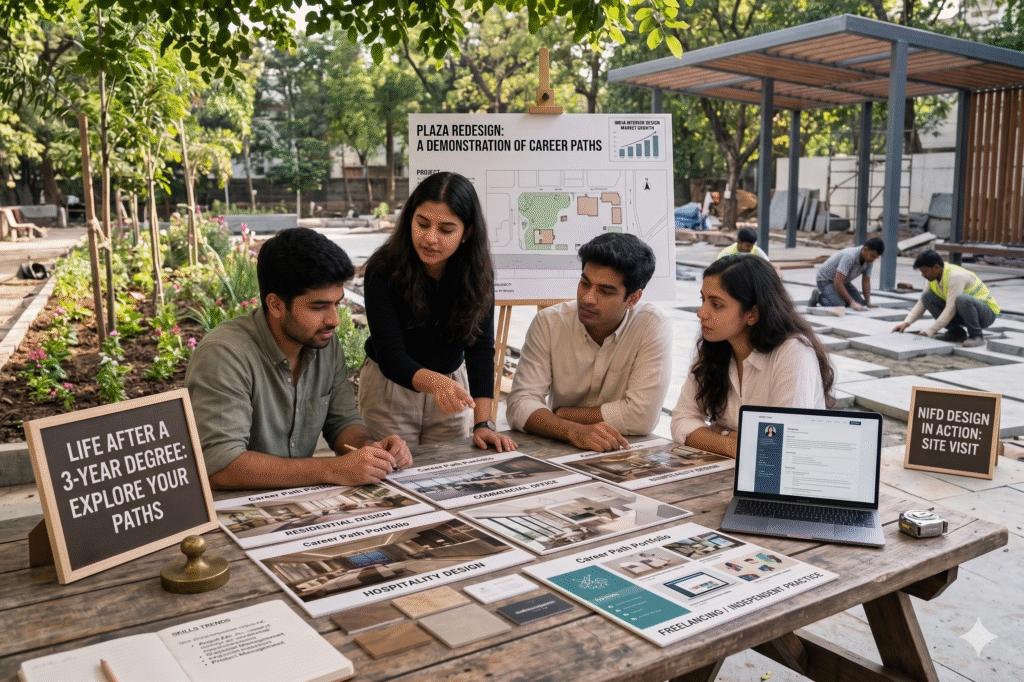
Explore the best interior design career paths and careers after an interior design degree in India. From residential design to freelancing, explore every opportunity a 3-year degree opens.
Three years of studio projects, material samples, AutoCAD drawings, site visits, and late-night renders have brought you to the finish line. You have your degree in hand and a portfolio that reflects hundreds of hours of creative and technical work. Now comes the question every graduate faces at this exact moment: what do you do with it?
The honest answer is: more than most people realize. Interior design career paths in India have never been broader, more commercially significant, or more creatively diverse than they are right now. India’s interior design industry was valued at USD 36.89 billion in 2025 and is projected to reach USD 74.73 billion by 2034, growing at a CAGR of 8.16% (IMARC Group, 2025). Urbanization, rising disposable incomes, a booming real estate sector, and a generation of homeowners and businesses with genuinely sophisticated design expectations are all driving demand for professionally trained designers at every level of the market.
This guide walks through every major direction your careers after interior design degree can take, the salary benchmarks you can expect, the skills employers are looking for, and how to build the portfolio that opens the right doors.
What Can You Do After a 3-Year Interior Design Degree
The first thing to understand about interior design career paths after a three-year degree is that the field is far wider than the popular image of a designer choosing paint colors and furniture for residential clients. A three-year interior design qualification trains you to think spatially, to solve complex human-environment problems, to communicate design intent through drawings and presentations, and to manage projects from concept to completion. These are skills that the market values across an extraordinary range of industries and contexts.
Careers after interior design degree can take you into residential and commercial design studios, architecture firms, real estate developers, hospitality groups, healthcare organizations, retail brands, film and television production companies, exhibition design agencies, government urban development bodies, furniture and material companies, digital design platforms, and your own independent practice. The range is genuinely broad, and the career you build depends significantly on the specialization you pursue, the skills you develop beyond your core qualification, and the professional networks you cultivate from the earliest stages of your working life.
A three-year degree in interior design from a reputable institution is recognized as a professional qualification by the industry in India. It is sufficient to enter the field at a professional level and to build a career that grows substantially with experience. Graduates who have studied at institutions like NIFD (National Institute of Fashion Design) or completed a 3-year interior design program with strong technical and portfolio foundations are consistently sought after by studios, developers, and firms across the country.
Residential vs Commercial Interior Design Careers
The most fundamental division in interior design career paths is between residential and commercial design, and understanding this distinction early helps graduates make more targeted decisions about where to apply their skills and how to position themselves in the job market.
Residential interior design involves creating living environments for private clients: apartments, houses, villas, and sometimes large luxury estates. It is the most personally intimate of all careers after interior design degree, requiring strong client relationship skills alongside technical design competence. Residential projects tend to be highly customized, with design decisions driven by the individual client’s preferences, lifestyle, and budget. The working relationship is close and ongoing, often spanning months or years across a single project.
In terms of salary, residential interior design is a rewarding but often slower-growing path in the early years. Entry-level positions at residential design studios in India typically offer Rs. 3 to Rs. 5 LPA, and residential-focused designers sometimes plateau below Rs. 8 LPA unless they transition into the premium luxury residential segment or take on business development responsibilities. The commercial ceiling in luxury residential design, however, is significant: senior designers working on high-end private residences in metros like Mumbai, Delhi, and Bengaluru command substantial fees and can earn Rs. 15 to Rs. 25 LPA and above.
Commercial interior design encompasses the design of office spaces, retail stores, restaurants and cafes, hotels and resorts, hospitals and clinics, educational institutions, airports, and other non-residential built environments. It is a broader and often faster-growing segment of interior design career paths in India because the scale of projects is larger, the production timelines are more structured, and the client base includes corporations and institutions with dedicated facilities budgets.
The salary premium in commercial design is well-documented. Commercial interior designers consistently earn 25 to 40% more than residential designers at the same experience level. According to AmbitionBox and Naukri.com’s 2025 interior design salary data, graduates placed in hospitality and commercial sectors started at an average of Rs. 4.8 LPA, compared to Rs. 3.2 LPA for those placed at residential design studios, a 50% difference at the entry point alone. For graduates who want faster salary progression and exposure to large-scale, complex projects, commercial design is the more financially rewarding initial direction in careers after interior design degree.
Specialized Career Paths in Interior Design
Beyond the residential and commercial divide, interior design career paths offer a rich landscape of specializations that allow graduates to develop deep expertise in a specific type of space or design discipline. Specialization typically comes after two to three years of broader experience, but understanding these paths early helps graduates direct their initial career choices with long-term intent.
Hospitality design, which covers hotels, resorts, restaurants, spas, and entertainment venues, is one of the most creatively rich careers after interior design degree. Hospitality projects require designers to balance the aesthetic vision of a brand with the operational requirements of a commercial space and the experiential expectations of guests. India’s booming hospitality sector, driven by both domestic tourism and international travel, generates consistent demand for talented hospitality designers.
Healthcare interior design is one of the fastest-growing and most socially significant interior design career paths in India. The logic behind this specialization is evidence-based: research consistently shows that well-designed hospitals reduce patient stress, improve recovery times, and reduce medication errors. India is investing heavily in healthcare infrastructure, with the sector projected to reach USD 638 billion by 2025, and interior designers who understand evidence-based design principles, infection control requirements, wayfinding systems, and universal accessibility are increasingly in demand. This is a specialization that offers both career differentiation and genuine social impact.
Retail design is a specialization within careers after interior design degree that sits at the intersection of interior design and brand strategy. Retail designers create the physical environments in which brands sell their products, and their work directly affects consumer behavior, dwell time, and purchase decisions. With India’s retail sector expanding rapidly across both physical stores and experience-driven retail formats, retail design is a growing area of opportunity within interior design career paths.
Sustainable design is rapidly becoming a mainstream rather than niche specialization across all categories of interior design career paths. Designers with certifications or demonstrated expertise in healthcare, sustainable design, or hospitality design consistently earn 20 to 35% more than generalists at the same experience level. Sustainable interior design involves working with eco-friendly and low-impact materials, designing for energy efficiency and natural light optimization, and applying green building principles such as LEED and GRIHA certification standards to interior environments.
Exhibition and set design is a creative specialization within careers after interior design degree that attracts designers drawn to theatrical, experiential, and temporary spatial work. Museums, galleries, trade shows, film sets, and cultural exhibitions all require designers who can conceptualize and execute immersive spatial experiences, often within tight timelines and production constraints. This is a path that rewards designers with strong conceptual thinking, quick visualization skills, and the ability to work effectively under production pressure.
Freelancing and Entrepreneurship Opportunities
One of the most significant advantages of interior design career paths relative to many other professions is the genuine viability of independent practice. Freelancing and entrepreneurship are not just aspirational endpoints for experienced designers. They are accessible from relatively early in a graduate’s career, particularly in the current environment of digital marketing tools and direct-to-consumer platforms that have lowered the barriers to building a client base independently.
Freelance interior designers take on projects independently, working directly with residential or commercial clients without the overhead of a studio or the constraints of an employer’s aesthetic or commercial direction. The financial upside of successful freelancing is significant: experienced freelancers with a strong portfolio and established client network can earn considerably more per project than their salaried counterparts at equivalent experience levels. The trade-off is income variability, particularly in the early years, and the additional burden of managing all business functions independently.
The most effective approach to careers after interior design degree through freelancing is to spend two to three years building skills, portfolio content, and professional contacts through full-time employment before transitioning to independent practice. The studio experience provides the professional foundation that makes freelance work sustainable, while the contact network developed during employment often provides the first clients when the transition to independence happens.
Entrepreneurship through launching a design studio is the most ambitious of all interior design career paths, requiring a combination of design excellence, business acumen, marketing capability, and financial management that goes well beyond what a three-year degree alone can provide. Successful design studio founders in India, including those behind recognized firms like Studio Lotus, Morphogenesis, and Carafina, have typically spent years in employment developing their design philosophy, building their reputations, and accumulating the client relationships and industry networks that a new studio needs to sustain itself.
Digital platforms for interior design, including services like Livspace and Homelane, have created a new category within careers after interior design degree that sits between traditional studio employment and independent freelancing. These platforms connect designers with residential clients through a managed digital marketplace, providing lead generation and project management support in exchange for a portion of project fees. For graduates who want to work independently but benefit from platform-level marketing infrastructure, this hybrid model offers an accessible entry point into client-facing design work.
Skills Employers Look for in Interior Design Graduates
Understanding what employers prioritize when hiring for interior design career paths gives graduates a clear map for how to invest their development time both during and immediately after their degree.
Technical software proficiency is the single most frequently cited requirement in interior design job postings in India. A 2024 analysis of interior design job postings on Naukri.com found that roles requiring AutoCAD or Revit proficiency carried an 18 to 22% salary premium over roles with no software requirements listed. For careers after interior design degree, this means that proficiency in AutoCAD for technical drawings, SketchUp or Rhino for 3D modeling, and visualization software like Lumion, V-Ray, or Enscape for rendered presentations is not optional. It is the baseline expectation at entry level.
Space planning and technical drawing skills are the practical foundation of all interior design career paths in professional practice. The ability to read and produce accurate floor plans, section drawings, elevation drawings, and reflected ceiling plans, and to understand the code and compliance requirements that govern built space, is essential for any graduate entering a professional design role.
Project management competency is valued increasingly highly by employers across all careers after interior design degree, particularly in commercial and hospitality design contexts where projects involve multiple contractors, suppliers, regulatory authorities, and client stakeholders simultaneously. Understanding how to manage a project timeline, coordinate between trades, track budgets, and maintain clear communication across all parties is a skill that develops with experience but should be cultivated actively from the first professional role.
Presentation and communication skills are consistently cited by design employers as differentiating factors between candidates with otherwise similar technical qualifications. The ability to present a design concept compellingly to a client, to explain technical decisions in non-technical language, and to represent design work through high-quality visualizations and mood boards determines how effectively a designer’s ideas are received and approved. These skills are directly developed through the portfolio and presentation work that good design programs build into their curricula.
Material and product knowledge, the practical understanding of what is available in the market, how different materials perform in different applications, and what things actually cost, is a form of intelligence that separates practically capable designers from merely conceptually strong ones. Building this knowledge requires deliberate engagement with the market through showroom visits, material fairs, supplier relationships, and site observations throughout the early years of interior design career paths in practice.
Emerging Trends in the Interior Design Industry
The interior design career paths of the next decade will be shaped by several powerful trends that are already transforming how designers work, what clients expect, and what skills the market rewards most highly.
Digital visualization and virtual reality are among the most significant technological developments in careers after interior design degree right now. Clients increasingly expect to experience a proposed design in immersive three-dimensional form before any physical work begins, and designers who can deliver photorealistic renders, virtual walkthroughs, or augmented reality previews through platforms like Enscape, Lumion, and Matterport are commanding a premium across the market. VR and AR tools are also changing how design revisions are communicated and approved, significantly reducing the number of costly physical changes made during construction.
Biophilic design, the intentional incorporation of natural elements, materials, light, and spatial patterns into the built environment to support human wellbeing, is one of the most rapidly growing specializations within interior design career paths. Research consistently demonstrates that biophilic design reduces stress, improves productivity, and enhances recovery in healthcare settings, driving adoption across residential, corporate, hospitality, and healthcare sectors simultaneously.
Smart homes and intelligent commercial spaces are creating new technical requirements for interior designers working in careers after interior design degree. Designers who understand how to integrate home automation systems, smart lighting, acoustic design, and building management technologies into their spatial design work are increasingly sought after, particularly in the premium residential and high-specification commercial sectors where these technologies are now standard client expectations.
The wellness design movement, which applies evidence-based research on the relationship between physical environments and human health, productivity, and psychological wellbeing, is creating a new framework for how spaces are designed and evaluated. For graduates pursuing interior design career paths in corporate, healthcare, or residential luxury sectors, understanding wellness design principles, including circadian lighting design, acoustic comfort, air quality, and spatial proportions that reduce cognitive load, represents a significant and growing professional differentiator.
How to Build a Successful Interior Design Portfolio
A portfolio is the single most important asset in any graduate’s pursuit of interior design career paths. It is the evidence that transforms your degree from a credential into a demonstration of professional capability, and in a visually driven industry like interior design, it does more to determine your first job and your first client than any other element of your professional presentation.
A strong portfolio for careers after interior design degree includes a range of project types that demonstrate versatility alongside technical depth. At minimum, it should include residential and commercial projects, showing that you can work across different client contexts and spatial scales. Each project should be presented as a complete narrative: from the initial brief and concept development through material selection, technical drawings, and final visualization or photography. This structure shows not just what you designed but how you think, which is what employers and clients are most interested in evaluating.
Technical drawings form an essential component of any professional interior design portfolio. Floor plans, sections, elevations, furniture layouts, and reflected ceiling plans that are drawn to a consistently high standard demonstrate that your design work is production-ready and not just visually attractive. Alongside these technical documents, high-quality rendered visualizations or, for completed projects, professionally photographed spatial photography show the final design intent at its most compelling.
Material boards and specification documents add a layer of professional credibility that sets careers after interior design degree portfolios apart. Showing that your material choices are informed, considered, and market-aware, with actual swatches or sourcing references rather than abstract color palettes, signals practical professional readiness to any experienced reviewer.
Digital presentation is now as important as the physical portfolio in most interior design career paths contexts. A personal website that showcases your work beautifully on both desktop and mobile, with a clean navigation structure and fast-loading, high-quality images, extends your professional reach to the global market and allows you to update your work continuously as your career develops. Platforms like Behance and Archinect are also well-regarded within the design community as professional portfolio hosting environments.
Keeping the portfolio actively updated is as important as building it. As you complete new projects, gain new skills, and develop a clearer professional identity, older work should be replaced or supplemented with stronger material. The portfolio that gets you your first job should look quite different from the one that gets you your third, and maintaining this discipline of continuous curation is a professional habit that successful designers in all interior design career paths sustain throughout their careers.
Salary Expectations After a 3-Year Interior Design Degree
Understanding salary benchmarks is essential for planning a realistic financial trajectory across interior design career paths in India.
Experience Level | Monthly Salary | Annual Salary |
Entry-Level (0 to 2 years) | Rs. 20,000 to Rs. 40,000 | Rs. 2.5 to Rs. 5 LPA |
Mid-Level (3 to 6 years) | Rs. 40,000 to Rs. 80,000 | Rs. 5 to Rs. 10 LPA |
Senior Level (7 years and above) | Rs. 80,000 to Rs. 2 Lakh | Rs. 10 to Rs. 24 LPA |
Principal Designer / Studio Head | Variable | Rs. 20 to Rs. 35 LPA and above |
Freelance / Entrepreneur | Variable | Rs. 6 to Rs. 40+ LPA based on practice scale |
(Source: AmbitionBox 2025, Glassdoor India 2025, Naukri.com Interior Design Job Market Analysis 2024-2025, IMARC Group)
Several factors push salaries upward most reliably in careers after interior design degree: the sector of practice, with commercial and hospitality consistently outperforming residential; the city of work, with Mumbai, Bengaluru, Delhi NCR, and Hyderabad commanding the highest pay; software proficiency, with AutoCAD and Revit skills carrying an 18 to 22% premium; and portfolio quality, which in interior design functions as a resume and can determine salary outcomes independently of years of experience.
Yes, a 3-year interior design degree from a recognized institution is a professional qualification that is sufficient to enter the industry at a professional level. Most entry-level roles in residential and commercial design studios, architecture firms, and real estate development companies are accessible to 3-year degree holders. The quality of your portfolio, your software skills, and the practical experience you have gained through internships during the degree often matter more to employers than the duration of your qualification.
Interior design career paths extend well beyond architecture firms into real estate development, hospitality groups and hotel chains, healthcare organizations, retail brands, film and television production, exhibition design agencies, furniture and materials companies, corporate facilities management departments, government urban development bodies, and digital interior design platforms like Livspace and Homelane. Careers after interior design degree are genuinely multi-industry, and graduates who understand this breadth are better positioned to find opportunities aligned with their specific interests
Yes, and increasingly so. Interior design career paths in freelancing and remote work have been significantly enabled by digital tools including CAD software, 3D visualization platforms, video conferencing, and project management applications. Many residential projects can be managed substantially remotely, with site visits limited to key milestones. Experienced designers with strong portfolios and established client networks are well-suited to full freelance practice, while early-career designers often build toward this through a period of full-time studio employment that develops their skills and professional contacts.
The most important software for careers after interior design degree includes AutoCAD for technical drafting and space planning, SketchUp or Rhino for 3D modeling, Lumion or V-Ray for photorealistic rendering and visualization, Adobe Photoshop and InDesign for presentation and portfolio documentation, and Revit for Building Information Modelling (BIM) in larger commercial and architecture-integrated projects. CLO3D and specialized visualization tools like Enscape are increasingly valuable additions for designers working on high-specification projects.
A portfolio is the most important asset in any interior design career path. In a visually driven profession where design quality cannot be adequately assessed from a CV alone, your portfolio is effectively your primary application document. Employers reviewing candidates for careers after interior design degree consistently prioritize portfolio quality above academic results, and a well-documented, beautifully presented portfolio of strong projects will consistently outperform a stronger academic record without one.
Yes, though most industry professionals recommend building foundational skills and industry networks through two to three years of employment before launching an independent practice. Starting a design studio requires not just design competency but business management, client acquisition, financial management, and project management skills that develop most effectively through experience in a professional studio environment. That said, ambitious graduates who begin developing their freelance client base alongside employment, through small personal projects and word-of-mouth referrals, can transition to full independence earlier than those who wait until they feel entirely ready.
For a comprehensive global perspective on interior design industry trends, career development, and the evolving standards of professional practice, visit Dezeen’s Interior Design Career Guide, one of the most trusted international platforms for design professionals worldwide.
Ready to build the foundation for a successful interior design career path? Explore NIFD’s interior design programs and discover the 3-year interior design degree course that gives you the technical skills, portfolio depth, and industry connections to launch your career with confidence.