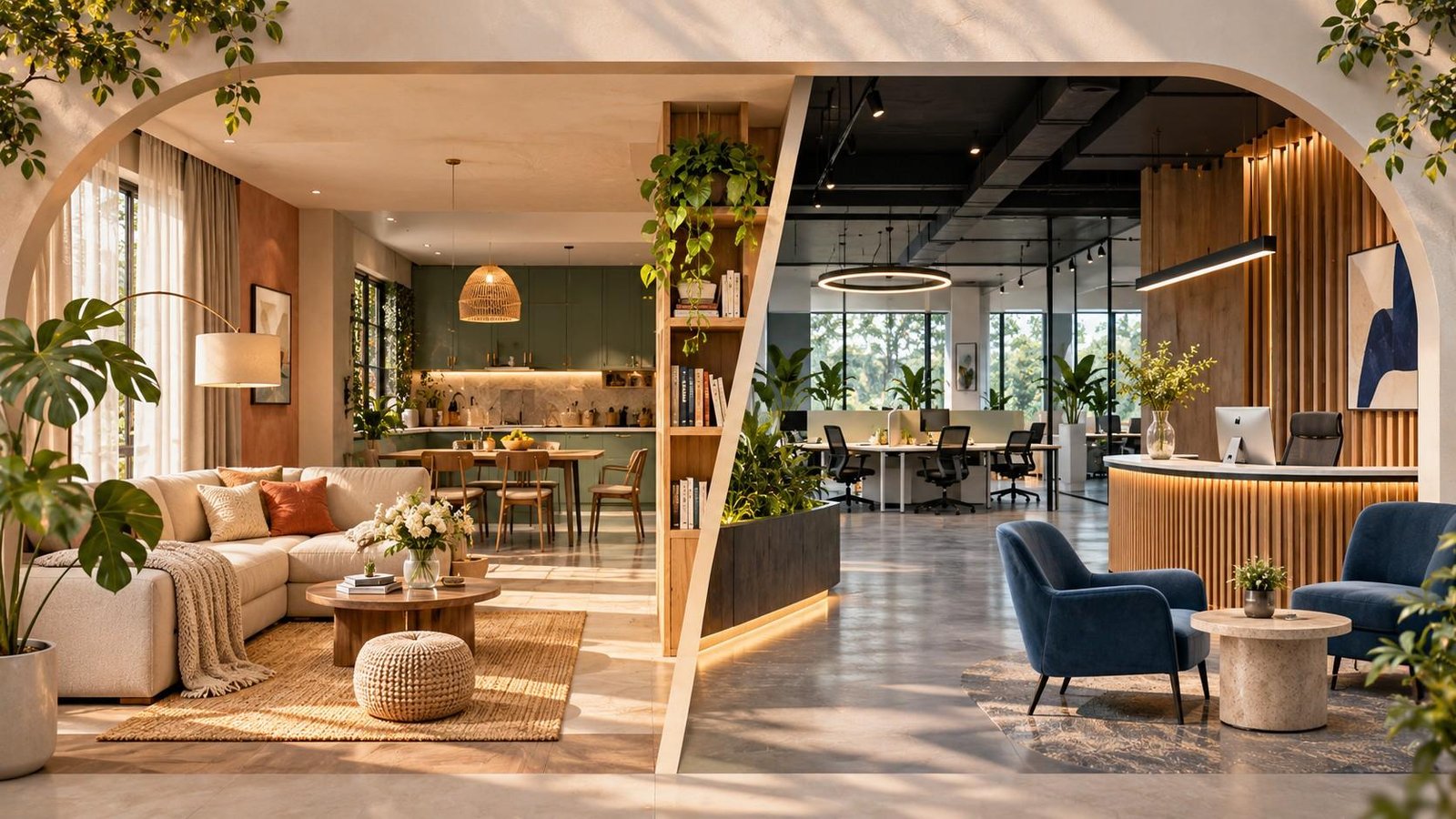
Residential vs commercial interior design represents two of the most distinct paths an aspiring designer can take within the same field. Both involve transforming built spaces into functional, visually considered environments, but the nature of the work, the people it serves, and the skills it requires differ considerably between them. Designing a home means understanding how a family lives, relaxes and uses personal space. Designing a commercial property means considering business operations, customer journeys, employee productivity and brand identity, often within tighter regulatory and durability requirements.
For students exploring interior design career opportunities in India, understanding where these two specialisations differ is a practical starting point for making a more informed decision about which direction to develop. The choice is not always permanent; many designers work across both areas as their experience grows. But knowing what each specialism actually demands, in terms of daily work, technical knowledge and professional skills, helps students focus their training and early career decisions more deliberately.
What Is Residential Interior Design?
Residential interior design is the practice of designing private living spaces: apartments, independent homes, villas and other personal dwellings. The goal is to create environments that reflect the homeowner’s lifestyle, preferences and practical requirements while making the most of the available space.
Understanding homeowners’ lifestyles and functional requirements is at the core of this work. A residential interior designer must translate the daily routines, habits and preferences of real people into spatial decisions: where furniture sits, how rooms flow into each other, where storage is built in, and how light moves through the home across different times of day. Planning layouts, furniture selection, lighting schemes, storage solutions and colour palettes requires balancing personal taste with practical function and budget reality. Creating comfortable, practical and visually cohesive interiors means working through a large number of detailed decisions, often in close collaboration with the homeowner, across a project that can range from a single room redesign to a complete home interior.
Examples of Residential Interior Design Projects
Residential interior design projects span a wide range: apartment and flat interiors, independent houses and villas, bedroom and living room design, modular kitchens and dining spaces, home offices and study areas, and both luxury and compact residential interiors. Each type of project brings its own spatial constraints, budget profile and homeowner expectations, requiring the designer to adapt their approach while maintaining consistent design quality throughout.
What Is Commercial Interior Design?
Commercial interior design is the practice of designing spaces used for business, professional and public activities. Where residential interior design centres on personal comfort and individual preference, commercial interior design centres on function, user experience, operational requirements and the communication of a business’s identity through its physical environment.
Understanding the purpose of a business and the needs of its users, whether those users are employees, customers, patients, students or guests, is the foundational task of a commercial interior designer. Planning layouts for movement, accessibility, productivity and customer experience requires a different kind of spatial thinking than home design: the scale is often larger, the number of different users is greater, and the design must serve operational goals rather than purely personal ones. Considering durability, maintenance requirements, relevant safety standards and appropriate lighting for different activity types is part of every commercial interior design brief. Creating spaces that reflect a company’s identity and operational needs means translating brand values and business culture into physical form, from the materials and finishes on the walls to the arrangement of furniture and the quality of light at a workstation.
Examples of Commercial Interior Design Projects
Commercial interior design projects include corporate offices and coworking spaces, retail stores and showrooms, restaurants, cafes and hospitality spaces, hotels and resorts, clinics and healthcare facilities, and educational institutions and training centres. Each category brings its own regulatory context, user requirements and design priorities, making commercial interior design a broad and varied specialisation that can develop in many different directions.
Residential vs Commercial Interior Design: Key Differences
The table below compares both specialisations across the factors that matter most when choosing a direction.
Factor | Residential Interior Design | Commercial Interior Design |
Primary users | Homeowners and families | Employees, customers, visitors |
Project scale | Single home or unit | Offices, retail, hospitality, healthcare |
Design priority | Comfort, personal preference, lifestyle | Function, brand identity, operational efficiency |
Client relationship | Close, personal, collaborative | Multiple stakeholders, broader team |
Durability requirements | Standard residential use | High-traffic, heavy-use environments |
Regulatory considerations | Building codes, residential standards | Safety regulations, accessibility, occupancy requirements |
Technical complexity | Moderate | Higher, often requiring specialist coordination |
Typical project duration | Weeks to months | Months to years |
Budget structure | Homeowner budget, often flexible | Business budget, often tightly managed |
Skills Required for Residential Interior Design
Understanding Lifestyle and User Preferences
Translating the daily habits, requirements and personal preferences of homeowners into functional spatial decisions is the most distinctly human skill in residential interior design. This requires genuine curiosity about how people actually live, patience in drawing out preferences that clients may not know how to articulate, and the ability to design spaces that work for real life rather than only for a photographed presentation. A residential interior designer who understands people well designs spaces that clients continue to love years after the project is complete.
Space Planning and Furniture Layouts
Making the best use of available space while maintaining comfortable movement, adequate storage and appropriate scale is a technical and creative challenge in every residential interior design project. Apartment interiors in particular demand precision in furniture selection and placement, where a few centimetres can make the difference between a space that feels open and functional and one that feels cramped. Developing a strong instinct for proportion and scale, grounded in technical measurement and planning discipline, is an essential part of this skill.
Colour, Material and Finish Selection
Choosing colour combinations, surface materials and finishes that complement both the home’s design concept and its practical requirements gives a residential interior design project its visual coherence and longevity. These choices must work together across different lighting conditions, through different seasons, and alongside the furniture and textiles the homeowner already owns or plans to acquire. A strong material and finish palette is both aesthetically resolved and practically durable enough to serve the household’s actual way of living.
Lighting and Storage Planning
Creating suitable lighting schemes for different rooms and activities, alongside practical and well-designed storage solutions, is where many residential interior design projects are won or lost in the client’s daily experience. A home with beautiful finishes but poor lighting or inadequate storage will fail to feel as well-designed as a simpler interior where these fundamentals are carefully considered. Understanding the layering of ambient, task and accent lighting, and designing storage that is both adequate and visually integrated, are skills that separate experienced residential interior designers from those earlier in their development.
Client Communication
Understanding individual expectations, presenting design choices clearly, managing the revision process and maintaining a productive working relationship through the full duration of a project are relational skills that determine the client’s overall experience as much as the design outcome itself. Homeowners are deeply invested in their personal spaces, and the ability to navigate their preferences, concerns and changing ideas with patience and professionalism is as important to a successful residential interior design practice as the creative and technical work.
Skills Required for Commercial Interior Design
Functional Space Planning
Organising spaces around specific business activities, customer journeys and employee requirements is the core spatial challenge of commercial interior design. A corporate office must support focused individual work, collaborative team activity and client-facing interaction, often within the same floor plate. A retail interior must guide customers through a purchasing journey while making products accessible and the brand experience consistent. This kind of purposeful spatial planning requires a deep understanding of how different types of users behave in different types of environments.
Technical and Design Understanding
Developing layouts and design concepts that account for building requirements, appropriate material specifications and technical coordination across multiple disciplines requires a broader technical knowledge base than most residential interior design work. A commercial interior designer must be able to read and produce technical drawings, work within structural constraints, coordinate with mechanical, electrical and plumbing engineers, and ensure their design decisions comply with relevant safety and building regulations. This technical fluency is what allows a designer to execute their creative vision in complex built environments.
Brand and Visual Identity
Translating a business’s identity, values and culture into its physical environment is one of the most distinctive creative challenges in commercial interior design. The materials, colours, lighting quality, spatial proportions and even the acoustic character of a commercial interior all communicate something about the organisation that occupies it. A commercial interior designer who understands brand communication at this level creates spaces that strengthen a business’s identity and reinforce the experience its customers and employees associate with it.
Material Durability and Maintenance
Selecting suitable finishes and materials for spaces that may experience intensive and frequent use by large numbers of people is a practical discipline that has significant cost and operational implications. Commercial interior design projects in hospitality, retail and healthcare environments in particular require materials that maintain their appearance through heavy use, can be cleaned efficiently, and will not require premature replacement. Specifying materials that are both visually appropriate and genuinely fit for purpose is a skill built through experience with real project outcomes.
Project Coordination
Working with clients, contractors, architects, structural consultants and suppliers across the full duration of a commercial interior design project requires coordination and communication skills that go beyond the design work itself. Larger projects involve multiple stakeholders with different priorities and timelines, and the ability to keep a project moving forward through these complexities, managing decisions, resolving conflicts and maintaining the design intent through the construction process, is what ultimately determines the quality of the delivered outcome.
Career Opportunities in Residential vs Commercial Interior Design
Career Opportunities in Residential Interior Design
The residential interior designer career path includes roles such as junior interior designer, residential space planner, kitchen and wardrobe designer, home renovation designer and interior design consultant. With experience, residential designers often build independent practices, working directly with homeowners on a project basis. Many combine employment in a design studio or firm with independent residential clients as their portfolio and reputation develop. Roles, responsibilities and earning potential vary with qualifications, portfolio quality, geographic market and the type of residential work undertaken.
Career Opportunities in Commercial Interior Design
Commercial interior design career paths include commercial interior designer, office space planner, retail interior designer, hospitality interior designer, exhibition and showroom designer, healthcare interior design professional and commercial design project coordinator. These roles exist within interior design firms, architecture practices, in-house corporate design teams, hospitality groups, retail organisations and specialist consultancies. The interior design career opportunities in India in the commercial sector have expanded significantly with the growth of the corporate office market, organised retail and the hospitality industry across Tier 1 and Tier 2 cities. Roles and progression depend on qualifications, practical experience, portfolio strength and the specific sector in which a designer develops their expertise.
How Do Residential and Commercial Interior Design Projects Work?
Both specialisations share a broadly similar project workflow. Understanding the client’s requirements is the starting point in every case, followed by site assessment and accurate measurements. Concept development and mood board creation give the design direction its visual reference, while space planning and layout development translate that direction into a workable spatial arrangement. Material, furniture and lighting selection fills out the design with specific products and finishes. Design presentations and revision rounds bring the client’s response into the process. Technical drawings and project coordination move the design into the production and construction phase. Execution, installation and final review complete the project and confirm that the design intent has been realised in the finished space.
Where the two specialisations diverge is in the complexity and scale of this process. Residential interior design projects often involve close, personal collaboration with a homeowner or family, with the designer as the primary professional the client interacts with. The scope is typically contained within one dwelling, and decisions, while detailed and numerous, are largely within the client’s personal authority to make. Commercial interior design projects frequently require coordination across larger teams including architects, structural engineers, mechanical and electrical consultants, fit-out contractors and multiple business stakeholders. Operational considerations such as phased construction to avoid business disruption, accessibility compliance and health and safety requirements add layers of complexity that are not typically present in residential work.
Residential vs Commercial Interior Design: Which Specialisation Should You Choose?
The most useful way to approach this choice is to consider the kind of work you will want to do consistently, not just the kind of project that sounds most appealing in description. Both specialisations involve creativity, technical knowledge, client interaction and the satisfaction of seeing a designed space come to life, but the daily experience of each is quite different.
Residential interior design is likely to suit you if you enjoy creating personal, comfortable spaces, understanding individual lifestyles in depth, and working in close collaboration with clients on the specific details of their home. The scale is more intimate, the client relationship is more personal, and the design decisions are more directly connected to how real people experience their daily lives.
Commercial interior design may be a better fit if you are drawn to larger-scale planning, more technically complex projects, designing for different types of users and business contexts, and working within teams that include multiple professional disciplines. The scope and stakeholder complexity of commercial projects suits designers who enjoy navigating complexity and seeing their work influence how organisations operate and how customers experience them.
Both directions allow for movement over time. Many designers begin in one specialisation and develop work across both as their experience and professional networks grow. Exploring different types of interior design projects through education, internships and early employment is the best way to build the informed perspective that makes this choice clearer.
What Should You Learn Before Starting an Interior Design Career?
Building a credible foundation for an interior design career requires developing a connected set of knowledge and practical skills rather than any single area in isolation. Design fundamentals, colour theory and composition give a designer the visual vocabulary to work across different project types. Space planning and furniture layout skills are essential to both residential interior design and commercial interior design, and developing them early creates a foundation that every subsequent project builds on.
Understanding materials, finishes and lighting at a practical level, beyond what a catalogue or showroom can convey, comes from handling samples, visiting sites and observing how specified materials actually perform in use. Technical drawing skills and familiarity with design software connect creative thinking to the production and construction process and are increasingly essential across both specialisations. Model-making, practical assignments and project documentation develop the habits of precision and thoroughness that professional practice demands. Portfolio development and presentation skills translate the quality of your design thinking into evidence that clients and employers can evaluate. And developing an understanding of real-world project workflows, through internships, studio visits and direct industry exposure, gives classroom learning its professional context and prepares a student for the realities of working in a design practice or firm.
Build Your Interior Design Foundation with INIFD
INIFD’s interior design programmes develop the creative, technical and practical knowledge that students need to enter and progress in the interior design career field. The curriculum covers design fundamentals, space planning, material knowledge, colour theory and technical drawing alongside practical project work that reflects real industry briefs and processes.
Students develop a working understanding of both residential interior design and commercial interior design contexts through structured assignments, design development exercises and portfolio-building projects. Industry exposure through internship opportunities and direct engagement with professional practitioners gives students the context they need to understand how design decisions are made and executed in practice, rather than only in theory. By graduation, students have the body of work, the foundational knowledge and the professional habits that allow them to enter the industry and continue developing their skills through real project experience.
Conclusion: Choosing Between Residential and Commercial Interior Design
Residential vs commercial interior design is ultimately a question about which kind of creative and professional work aligns most closely with your interests, strengths and long-term goals. Both specialisations share the same creative foundation: a commitment to designing spaces that work well for the people who use them, expressed through careful spatial planning, informed material selection and considered visual design. Where they differ is in the nature of those users, the scale and complexity of the projects, and the professional skills the work demands most consistently.
Understanding the difference between residential and commercial interior design at this level, through the actual projects, the daily skills and the career environments each involves, is the most reliable starting point for making an informed decision about which direction to develop and which kind of interior design career opportunities in India to pursue.
Frequently Asked Questions
Residential interior design focuses on private homes, designing for the comfort, lifestyle and personal preferences of individual homeowners or families. Commercial interior design focuses on business and public environments, designing for the operational needs, brand identity and user experience of employees, customers and visitors. The scale, technical requirements and client relationship differ significantly between the two.
Both specialisations present distinct challenges. Commercial interior design typically involves greater technical complexity, more regulatory requirements and coordination across larger project teams. Residential interior design demands deep interpersonal skill and the ability to translate highly personal client preferences into spatial decisions. The more challenging of the two depends on where your own strengths and interests sit.
Yes. Many interior designers build experience across both residential interior design and commercial interior design over the course of their careers, particularly as their portfolio, professional network and technical skills develop. Some designers maintain a practice that spans both, while others develop a specific focus in one area.
Residential interior design projects include apartment and flat interiors, independent homes and villas, bedroom and living room design, modular kitchens, home offices and both compact and luxury residential interiors. The scope can range from a single room to a complete home renovation or new-build interior.
Commercial interior designers are hired by architecture and interior design firms, corporate organisations, hospitality groups, retail brands, healthcare organisations, educational institutions and property developers. Many also work independently as specialist consultants or through their own design practices.
Yes. Commercial interior design requires a broader technical knowledge base than most residential interior design work, including familiarity with building regulations, accessibility standards, safety requirements and coordination with structural and engineering consultants. Technical drawing proficiency and the ability to work within complex project management structures are more consistently required in commercial practice.
Both offer strong interior design career opportunities in India, supported by the growth of residential real estate, organised retail, corporate office development and the hospitality sector. The commercial sector has expanded significantly in India's major cities and increasingly in Tier 2 markets, while residential design remains consistently in demand across all urban markets.
Yes, typically in junior or assistant roles within design firms or practices that handle commercial interior design projects. Entry-level positions provide the structured professional experience needed to develop the technical and coordination skills that more senior commercial design work requires.
Yes. Many designers begin their careers with residential interior design projects, which offer the opportunity to manage the full design process from brief to completion relatively early, develop a client-facing practice, and build a strong portfolio of completed work. It is also a specialisation where independent practice is accessible to designers earlier in their career development.
Students preparing for an interior design career should develop design fundamentals and colour theory, space planning and furniture layout skills, material and lighting knowledge, technical drawing ability, design software proficiency, and portfolio development and presentation skills. Practical project experience through structured assignments and internships is as important as classroom learning in building professional readiness.